A pattern worth investigating
Look at this screenshot.
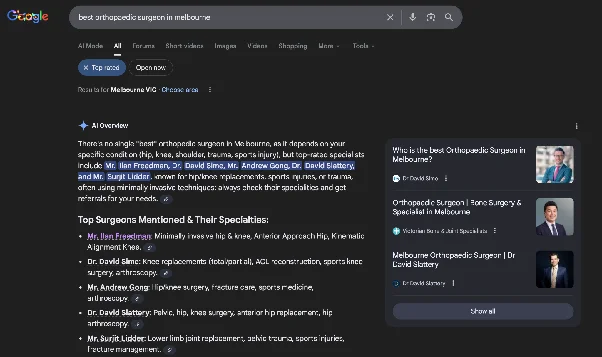
We searched "Best orthopaedic surgeon in Melbourne" and Google's AI Overview did something fascinating. It didn't just return search results. It actually named surgeons. Mr. Ilan Freedman, Dr. David Sime, Mr. Andrew Gong, Dr. David Slattery, Mr. Surjit Lidder.
And here's where it gets interesting. We went down the rabbit hole. Checked out every single surgeon that got named. And they all have one thing in common.
Every. Single. One. Has their own personal website.
Every surgeon in this small sample had their own website. That makes personal websites worth examining as part of the wider digital picture, but not as a proven cause of inclusion. Not a profile buried in Epworth's directory. Not a bio page on Melbourne Orthopaedic Group's site. Their own domain. Their own digital real estate. Their own brand.
That observation is interesting, but it does not establish why Google selected those names. A small sample cannot isolate the effect of a personal website from other signals.
Google's AI doesn't just match keywords - it reads your story
Something fundamental shifted in 2024 when Google rolled out AI Overviews. The old game was about keywords, backlinks, and technical SEO tricks. The new game is about something much harder to fake: semantic understanding.
Google's AI now reads content the way a human would. It understands context, intent, and relationships between concepts.
It now reads. Like actually reads and comprehends content the way you would. It's looking at a webpage and asking: Who is this person? What's their story? Where did they train? What makes them special? Do other credible sources back up what they're claiming?
This is where E-E-A-T becomes critical. Experience, Expertise, Authoritativeness, and Trustworthiness. Google has always cared about these signals, but E-E-A-T remains useful as a way to think about the quality and trust signals Google describes, but it is not a score we can observe or a guarantee of AI Overview inclusion. The algorithm isn't just ranking pages anymore, it synthesises and recommends specific people by name. And it's only recommending people it trusts.
Think about what that means for a surgeon relying on a hospital profile page. That page wasn't written to tell your story. It wasn't optimised to communicate your unique training, your fellowship in Switzerland or Harvard, your subspecialty in anterior hip replacement. It's a template. A generic bio alongside fifteen other surgeons. The AI reads it and sees... nothing distinctive. Nothing that screams "this is a top surgeon worth recommending."
Not a formal study, but the pattern is hard to miss
So we looked up every surgeon Google's AI recommended. And man, the pattern is so clear it's almost funny.
Mr. Ilan Freedman? He's got melbournehipsurgeon.com.au. His whole site tells this story about training in Paris with some renowned hip surgeon named Dr. Frederic Laude at Clinique du Sport, plus another fellowship in the UK. It positions him as the anterior approach guy. The kinematic alignment knee guy. Very specific. Very memorable.
Dr. David Sime? He's got davidsime.com.au. His narrative is all about his Masters from University of Edinburgh, fellowship at Royal Infirmary of Edinburgh, then sports knee surgery at Fortius Clinic in London - which is apparently a FIFA-certified centre of excellence. Site mentions he worked with English Premier League players and Olympic athletes.
We can keep going...
That's not generic hospital bio energy. That's story. That's what keeps you reading and interested.
Five surgeons. Five personal websites. It's a small sample, and we haven't checked what the surgeons who didn't get featured look like, but the pattern is worth noticing.
Every single one controls their own narrative. Every single one has a platform that tells their unique story, their approach to surgery, their sub-specialty. And crucially, every single one appears in Google's AI Overview when someone searches for the best orthopaedic surgeon in Melbourne.
The surgeons on hospital profile pages? Nowhere to be seen.
Here's what's actually happening under the hood
Okay, time to nerd out for a second because this is actually fascinating.
Google's AI is trying to answer a genuinely hard question: "Who are the best orthopaedic surgeons in Melbourne?" To answer that, it needs what the SEO people call "semantic authority". This is basically a clear, consistent signal that a person is actually expert in a thing.
When your information is scattered across hospital directories and group practice websites and random aggregator listings, the AI sees fragmented signals. It can't build a coherent picture. Each source tells a slightly different story. Different emphasis. Different details. It's noise.
But when you have your own website? You control the whole narrative.
You decide which subspecialties to emphasise. You decide how to frame your training. You decide which keywords appear naturally and repeatedly. You create one authoritative source that the AI can actually trust.
Your personal website, done right, becomes that authoritative source.
The language patients use, and the line you can't cross
Here's something subtle, and it's where a lot of surgeons are given bad advice.
Think about how patients actually search. Nobody types "orthopaedic surgeon with fellowship training in arthroscopic procedures of the lower extremity." They type "knee surgeon Melbourne", "ACL reconstruction Richmond", or yes, "best knee surgeon near me". Normal human language, superlatives and all.
It is tempting to conclude that you should therefore weave "top knee surgeon" and "best ACL doctor" into your own pages to match those searches. Don't. Under section 133 of the National Law, a registered practitioner cannot publish unsubstantiated superlatives, such as "best", "top" or "leading", about their own regulated health service. The superlative is the phrase a patient is free to type into Google; it is not a claim you are free to make about yourself. Publishing it is a direct route to an AHPRA complaint, and no ranking is worth that.
The reassuring part is that you do not need the superlative to rank. You target the topic, not the boast. A page that genuinely covers your work, meaning the conditions you treat, how ACL reconstruction actually works, what robotic knee replacement involves, who you see and where, builds the semantic connection between your name and knee-surgery expertise across your whole site. That is what an answer engine reads and trusts: authority earned from the depth and accuracy of your content, not from a word like "best" that you are not permitted to use anyway.
So you speak to both audiences honestly. Patients get clear, relatable content about the exact thing they searched for, and the AI gets the substantive signals it needs, without a compliance landmine buried in your copy.
The numbers are kind of scary
Estimates of the exact share vary depending on who is measuring, but AI Overviews now show up in a large and growing proportion of Google searches, and that share is climbing month on month.
This shift is accelerating. And the surgeons who show up in these AI answers didn't get there by accident. They built websites that tell their story. They created content that establishes authority. They played the long game.
The surgeons without personal websites? They're basically invisible in the searches that matter most. When someone types "best hip surgeon Melbourne" and Google's AI generates an answer, you're not in it. You can't be. There's no authoritative source for the AI to pull from. No story for it to tell.
You could be the most skilled surgeon in your specialty. You could have trained at the best institutions on earth. You could have outcomes that blow everyone else away.
What this means for your digital future
Estimates of the exact share vary, but AI Overviews are appearing in more Google searches every quarter. This isn't a trend that's going to reverse. This is the future of search.
And the surgeons who show up in these AI-generated answers aren't there by accident. They've invested in their own digital presence. They've built websites that tell their unique story. They've created content that establishes semantic authority across their subspecialties.
The surgeons who don't have personal websites? They're essentially invisible in the most important searches. When a patient types "best hip surgeon Melbourne" and Google's AI generates an answer, that answer won't include you. It can't. There's no authoritative source for the AI to pull from. No coherent narrative for it to synthesise. No semantic signals for it to trust.
You might be the most skilled surgeon in your specialty. You might have trained at the best institutions. You might have outcomes that rival anyone in the country. But if Google's AI doesn't know your story, you don't exist in the moments that matter most - when patients are actively searching for someone like you.
The uncomfortable reality
Here's the uncomfortable reality: the surgeons winning at this game aren't necessarily better surgeons. They're surgeons who understood earlier that digital presence is now part of the game. They invested in their own platform. They wrote content that speaks to both patients and algorithms. They played the long game while everyone else was hoping the old rules would stick around.
The good news? It's not too late. The patterns are clear. The playbook is visible. Google's AI rewards personal websites that demonstrate genuine expertise, tell compelling stories, and establish semantic authority through consistent, authentic content.
The question is whether you're going to build that digital foundation or continue hoping that a hospital profile page will somehow be enough in an AI-driven search landscape.
Want to build something that actually gets you recommended?
At BusyBeeDoc, we build websites specifically for surgeons who want to show up when AI does the answering. We get how Google evaluates authority, how semantic signals work, and how to tell your story in a way that both patients and algorithms trust.
If you're tired watching less qualified surgeons show up in AI Overviews while you stay invisible, let's fix that. Check out busybeedoc.com and see how we help surgeons own their digital presence in the AI era.